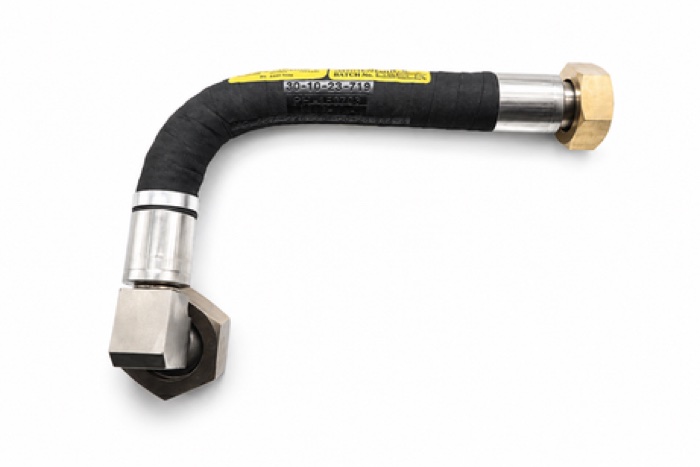
A warship's pipework is built to a shock specification a plant room never meets. A rigid run carries every vibration from the machinery into the structure, and cracks at the joints under shock. On a submarine, the noise a rigid run transmits is a problem of its own. The joint at the machinery has to absorb what the machinery produces, not pass it on.
Solutions
Six things a flexible hose has to survive on a ship.
On a ship, the flexible hose is the smallest part in the system and the first place a commodity choice fails. It sits exactly where the movement, the heat and the shock are. Rigid pipework corrodes, cracks and carries every vibration into the system. A metallic flexible hose has limited movement across multiple planes, so it is less suited where movement comes from several directions at once. An industrial hose has no naval type approval and cannot go on a warship.
Jetpac® is built for all six, and qualified before it goes on board. Start with the one you are dealing with.
Jetpac® preform
Approved to
Approvals, certificates and qualityFire resistance and survivability
Fire in the compartment.
"It has to survive a compartment fire and keep holding pressure."
- Problem
A machinery-space fire does not wait for the system to be isolated. A fuel, lube-oil or hydraulic line that lets go in the first minutes feeds the fire and takes the system with it. Where the answer is a fire sleeve, that is one more part to fit, inspect, strip off for maintenance and refit afterwards, and one more part to forget. What you want is a line that keeps carrying fluid through the fire with nothing bolted on.
- What Jetpac® does
The fire resistance is in the rubber itself, not in a fire sleeve. A Jetpac® assembly carries fluid under pressure through the fire test on its own, so there is no fire sleeve to fit and no restraining rings to hold it. Nothing to add, nothing to inspect, nothing to strip off when the system is opened. The hose is its own fire protection.
- The standard
Built to UK MOD Def Stan 02-345: 15 minutes at 1,100°C while pressurised and vibrated. Type approved by Lloyd's Register, DNV and ABS. Fire tested in our own test house, at high and low pressure. Smoke and toxicity verified independently through RAPRA.
Behind it
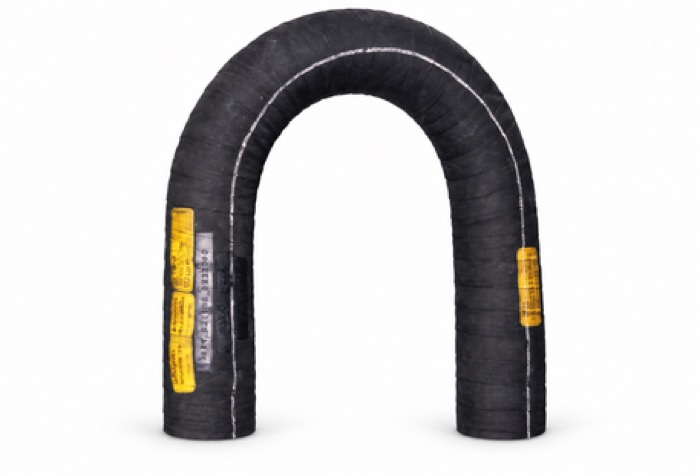
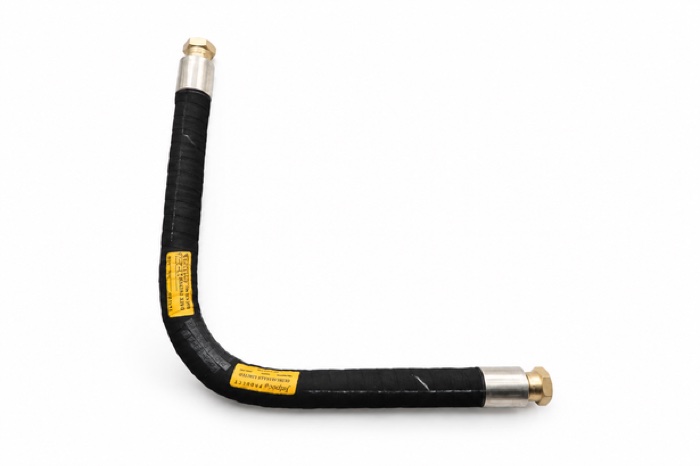
Preformed 90° and 180° assemblies
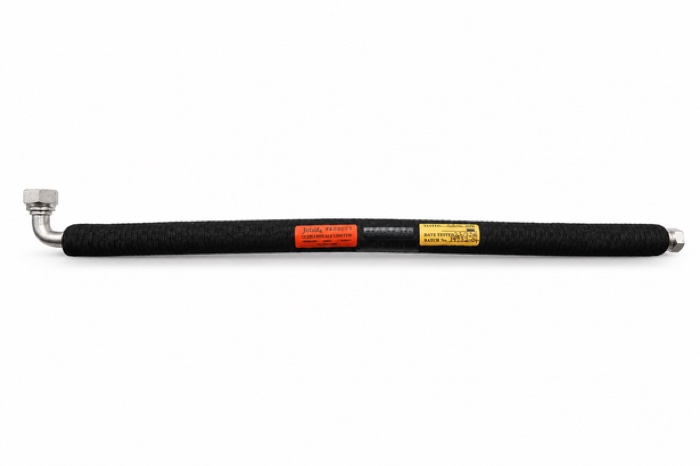
Straight hose assemblies
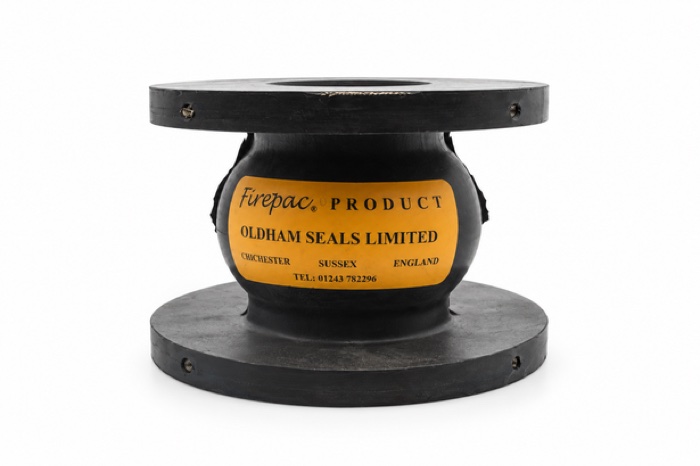
Rubber bellows
All integrally fire-resistant.
- Fuel and aviation fuel
- Main propulsion and lube oil
- Diesel generators
- Fire main, ballast and bilge
- Fire testing in the test house
Shock, vibration and noise
Shock, vibration and noise.
"Every vibration from the machinery ends up in the compartment."
A flexible assembly at the machinery isolates the pipework from the plant. The high-shock, high-vibration construction absorbs movement instead of transmitting it, takes the shock loads that break a rigid run, and cuts the structure-borne noise that, on a submarine, counts as much as the shock. The 180° dog-leg configuration gives movement in all three planes within one assembly.
Shock and vibration tested to MIL and NATO standards, by our customers and by UK MOD(N) in their own facilities. Pressure-pulsing combined with flexibility and deflection tested in-house.
Behind it

Preformed 90° and 180° assemblies

Rubber bellows

Straight hose assemblies
- Main propulsion and lube oil
- Diesel generators
- HP air, hydraulics and steering gear
- Submarines
- Naval surface ships
Movement, misalignment and space
The run won't line up.
"The run moves, expands and never quite lines up."
- Problem
Machinery spaces are tight and pipework is rarely aligned. Equipment moves on its mounts, the run grows with temperature, and the installation never matches the drawing exactly. A catalogue hose forces the layout around the part. A fabricated elbow adds a joint, a weld and a place to leak. The hose should be built to the installation, not the installation around the hose.
- What Jetpac® does
The geometry is set by your layout, not by a stock list. A 90° or 180° preformed assembly is built to the leg lengths of the installation, with movement in all three planes, so the hose fits the run instead of the run fitting the hose. Where the run turns back on itself, the 180° dog-leg takes the reversal in one piece. Designed in 2D and 3D CAD from your drawing. Manufacturing tolerances advised per installation, in writing.
Bore on preformed assemblies (25 to 350 mm).
Nominal bore across the range on bespoke assemblies.
Straight-hose configurations.
Bellows variants, so the standard answer usually already exists.
Behind it
Preformed 90° elbow assemblies
Preformed 180° assemblies
Bespoke assemblies and fittings
- Design engineering and CAD
Weight reduction versus metallic pipework
Metallic pipework and its hardware.
"The metallic pipework has corroded or cracked. Again."
A metallic expansion joint does the job, with help. It needs restraining rings to hold it, and the hours to strip all of it off when the system needs work. Every one of those parts is weight the ship carries for thirty years. In sea water, the metal corrodes and cracks as well. A metallic joint arrives as a kit. The alternative arrives as one part.
A Jetpac® assembly is its own fire protection and its own restraint. No restraining rings. No fire sleeves. One part to fit, one part to open, and lighter than the metallic joint plus its hardware. The rubber does not corrode in sea water, and the fittings are machined in the alloy the fluid demands. On in-service vessels, Jetpac® assemblies have replaced metallic pipework that had corroded and cracked.
What can be counted today.
Behind it
Rubber bellowsNo restraining rings
Preformed 90° and 180° assemblies
Straight hose assemblies
- Fire main, ballast and bilge
- Main propulsion and lube oil
- Diesel generators
Through-life hose integrity
Hoses ageing on board.
"Nobody can say which hoses on board are due, or when."
- Problem
Each hose has a recommended replacement date, and the one that reaches it before its replacement is ordered becomes a concession with a name on it. Today the register is a spreadsheet that disagrees with what is actually fitted, the survey takes days out of a refit window, and stock is over-ordered to cover the gap.
- What Jetrac does
The survey ends with a date against every surveyed hose. Jetrac, Oldham Seals' field division, puts engineers on board. They survey flexible hoses, other manufacturers' included, tag each one, record its condition and criticality in a web-accessible register, forecast replacement, supply and install.
- The standard
Hoses are recommended for replacement on a 5-, 10- or 15-year periodicity, depending on the application. Every Jetpac® assembly hydrostatically tested and released with full certification, so the register starts from a known date and a known condition.
Behind it
- Jetrac hose management
- Exchange and installation
- Naval surface ships
- Submarines
- Commercial and industrialWhere hose surveys are already standard practice

Jetrac hose management
Testing and qualification
You can't fit it until it's proven.
On a naval platform the part is not the cost. The qualification is. A hose without type approval and evidence to the relevant Defence Standards cannot be fitted, and a part that fails at test late in a programme costs the schedule, not the part. Testing done elsewhere happens late, and the schedule pays for it. The proof has to exist before the part ships, and the file has to arrive with it.
Small bore test pressure (2,900 psi).
Large bore test pressure (725 psi).
Def Stan 02-345 fire test, pressurised and vibrated.
Every Jetpac® assembly is hydrostatically pressure tested before it leaves Chichester, and every one is released with full release certification. Behind that sits our own test house: fire test rigs at high and low pressure; endurance, vacuum and pressure testing; pressure-pulsing combined with flexibility and deflection; impulse testing; all on rigs built to the standards our customers specify. Material ageing, fluid resistance, smoke and toxicity are verified independently through RAPRA. Independent chemical and mechanical certification of non-ferrous fittings is available. Connectors to BS, ISO, ASTM or ANSI as specified.
If you need a part qualified to a naval or customer standard, ours or yours, we can test it.
Behind it
- The Test House
- Approvals, Certificates and Quality
- Technical Data
Common to the range
Technical dataOne material family across sea water, Dieso F-76, AVCAT F-44, OX30, OX33 and OX40, OM100, OMD113 and OEP80, fresh, potable and chilled water.
Continuous.
Intermittent.
In service with UK MOD(N).
One loop, one company
Others can match a step. The loop is the part they cannot copy.
FAQ
Questions engineers ask before they call.
Send us the requirements and a drawing if you have one. An engineer will answer it.
Discuss your applicationNo. The material is integrally fire-resistant and is tested to Def Stan 02-345, 15 minutes at 1,100°C while pressurised and vibrated, so no fire sleeve is fitted. The same applies to restraining rings on Jetpac® bellows.
Yes. Send the drawing, or the requirements: fluid, pressure, temperature, bore, movement and the space available. Preform geometry and leg lengths are modelled in 2D and 3D CAD to the installation, and tolerances are advised in writing.
Fire-resistant. That is the term Def Stan 02-345 and the type approvals use: the assembly keeps carrying fluid under pressure through the fire test, 15 minutes at 1,100°C while pressurised and vibrated. Fire-retardant describes a material that resists ignition. Jetpac® is specified and tested as fire-resistant.
Yes. Jetrac tags, registers and manages other manufacturers' hoses alongside Jetpac®, and acts as first-tier supplier for the replacements.
Hoses are recommended for replacement on a 5-, 10- or 15-year periodicity, depending on the application. Jetrac tracks the dates of the hoses it surveys, so the replacement is ordered before the hose is due.
We do not publish programme detail, and we will not publish yours. What we can say: Jetpac® assemblies are in service on Royal Navy ships and submarines, and Oldham Seals exports to navies around the world.
Contact
Discuss your application.
You are responsible for systems that cannot fail at sea. The flexible hose should be the last thing you have to think about. Send us the fluid, pressure, temperature, movement and space you are working with, and a drawing if you have one. Our sales team routes it to the right engineer. You get feasibility and the standard we would qualify to within one working day. Your platform stays confidential: we do not publish what we build for you.